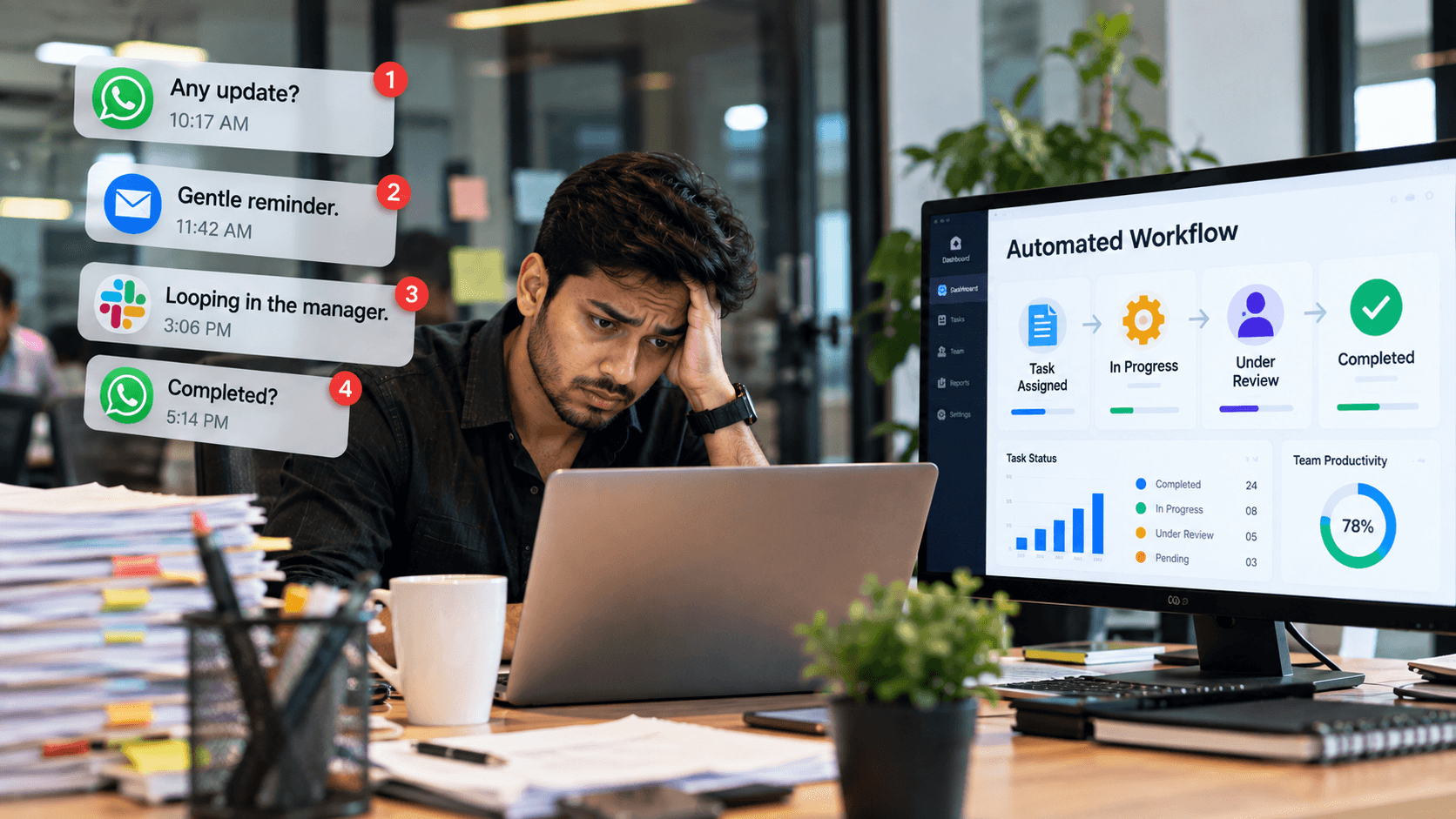
At 10:17 a.m., someone sends: "Any update?"
At 11:42 a.m.: "Gentle reminder."
At 3:06 p.m.: "Looping in the manager."
At 5:14 p.m.: "Completed."
Four messages. Three people. One task.
Nothing failed technically. No server crashed. No employee deliberately refused to work. Yet organisational time was consumed simply discovering whether work had moved.
We measure payroll, productivity, revenue and downtime. We rarely measure the time spent following up, reminding, checking status and escalating.
I think of this as the Chase Economy.
It is the hidden layer of work created when a business depends on people to remember what should happen next. And in 2026, that deserves more attention than another discussion about whether a company has adopted enough technology.
Technology was supposed to reduce friction
Businesses today have more digital tools than at any point in history: CRMs, ERP systems, dashboards, workflow platforms, AI assistants, analytics, project-management software and cloud applications.
Yet many organisations still depend on the oldest operating system in business: human memory.
Someone has to remember that an approval is pending. Someone has to notice that a customer has not been called back. Someone has to ask whether a payment was received. Someone has to escalate because a deadline quietly passed.
That is where digital maturity should be judged - not by how many applications an organisation owns, but by how much unnecessary chasing those applications have removed.
A business can have sophisticated software and still run on reminders, spreadsheets, inboxes and WhatsApp messages. That is not primarily a technology problem. It is an operating-design problem.
The cost of chasing is larger than it looks
A follow-up message may take thirty seconds, but its real cost is rarely thirty seconds. There is the interruption, the context switch, the search for earlier communication, the waiting time before a response arrives and often the escalation that follows.
Multiply that across hundreds of transactions, multiple departments and an entire year, and the cost becomes substantial.
More importantly, repeated chasing creates dependency on individuals. When a process works only because one employee remembers everything, the organisation does not truly own that process. The employee does.
That weakness becomes visible the moment the person is absent, overloaded, transferred or leaves.
A mature operating system should not depend on extraordinary memory. It should create ordinary reliability.
Good systems should know what happens next
Consider a simple customer enquiry. The customer should not need to call three times because one person is on leave.
The enquiry should already have an owner. Its priority should already be visible. The expected response time should already exist. A missed deadline should create an exception. If intervention is required, the right person should know before the customer needs to complain.
The same logic applies internally. An invoice should not remain unpaid because an approval is buried in someone's inbox. A project should not become 'urgent' because nobody noticed that a milestone slipped ten days ago. A sales lead should not disappear because one executive forgot the second call.
Technology becomes valuable when it turns these moments from human reminders into system behaviour.
Do not automate confusion
There is a temptation to automate everything that moves. That is dangerous.
If five unnecessary approvals exist, automating those five approvals does not create a better process. If nobody knows who owns a decision, adding an AI layer does not create accountability. If inaccurate data enters a system, faster processing simply produces faster inaccuracy.
Before automating a process, leaders should ask: Why does this process exist? Who owns it? What should happen automatically? What genuinely requires human judgement? What counts as an exception? When should leadership become involved?
Those are operational questions before they are technology questions.
AI should remove friction, not become another layer of it
Artificial intelligence is changing the role of software. Systems can increasingly interpret information, recommend actions and initiate parts of a workflow.
An AI system may qualify a lead, analyse customer sentiment, prepare a proposal, identify an abnormal transaction, prioritise a support request or recommend the next action.
The opportunity is significant. But the objective should not be to insert AI everywhere. It should be to identify where intelligence improves a decision, removes unnecessary effort or exposes a problem earlier.
One useful test is simple: does this technology eliminate an unnecessary human chase?
If it does, it may be solving a real operational problem. If it merely creates another dashboard that somebody has to monitor manually, the process may still be waiting to be redesigned.
The better model: routine flows, humans handle exceptions
The strongest operating systems do not require managers to monitor every routine transaction. They allow normal work to move and draw human attention to what is unusual.
A deadline is missed. A transaction looks abnormal. A customer is dissatisfied. A security event occurs. A decision requires judgement. A strategic opportunity appears.
Instead of managers repeatedly asking, "What is happening?", the system should be able to say, in effect: "This is where your attention is required."
That changes the role of leadership. Leaders spend less time acting as follow-up officers and more time making decisions.
Autonomy without trust is not maturity
As systems perform more work independently, trust becomes part of operational design.
Who can access the data? Who authorised an automated action? Can a decision be traced? Can a mistake be reversed? What happens when the system behaves unexpectedly? Where must a human remain in control?
This is why AI, cybersecurity, automation and operations increasingly meet inside the same business process.
An automated workflow without security is a vulnerability. AI without accountability is a risk. A beautifully designed digital experience without reliable execution is a broken promise.
Customers do not experience these as separate departments. They experience one organisation.
Less chasing may become a competitive advantage
Businesses compete visibly on price, speed, features, customer experience and marketing. But underneath those sits another advantage: operational reliability.
The company that responds without being reminded. The company that detects a problem before the customer reports it. The company where information reaches the right person without being manually forwarded. The company where managers see exceptions rather than hunt for status updates.
Customers may never know the architecture behind that experience. Employees may never use technical language to describe it. They simply notice that things move.
How TechDiveX thinks about the problem
At TechDiveX, technology should not exist merely to make an organisation look more digital. It should make the organisation work better.
A website should not simply look impressive; it should help a customer move forward. Digital marketing should not merely generate attention; it should connect attention with measurable outcomes. Automation should not demonstrate technical capability; it should remove unnecessary work. AI should improve a decision, accelerate a process or expose useful insight. Cybersecurity should be built into the systems on which the business increasingly depends.
Every digital investment should eventually answer one practical question:
What became easier, faster, safer or more reliable because we built this?
That thinking sits behind three simple words at TechDiveX:
Learn. Build. Grow.
Learn the real problem.
Build the right system.
Grow because the system creates value.
The sequence matters.
Perhaps the real measure of digital maturity is simpler
The organisation of the future may be surprisingly quiet.
Fewer emails asking for updates. Fewer managers hunting for information. Fewer customers wondering what happened to their request. Fewer tasks becoming emergencies simply because nobody noticed them earlier.
Technology will still be everywhere, but ideally people will notice it less. Work will move. Exceptions will surface. Risks will become visible. People will intervene where judgement matters.
And the organisation will become less dependent on somebody remembering to chase somebody else.
We have spent years asking businesses, "How digital are you?"
Perhaps the better question is:
How well does your business work when nobody is chasing it?